BagMaster Isekai – Bag Battle
- 4.3
- Rating
- 1.00M
- Installs
- Free
- Price

 Analysis by App-foxy
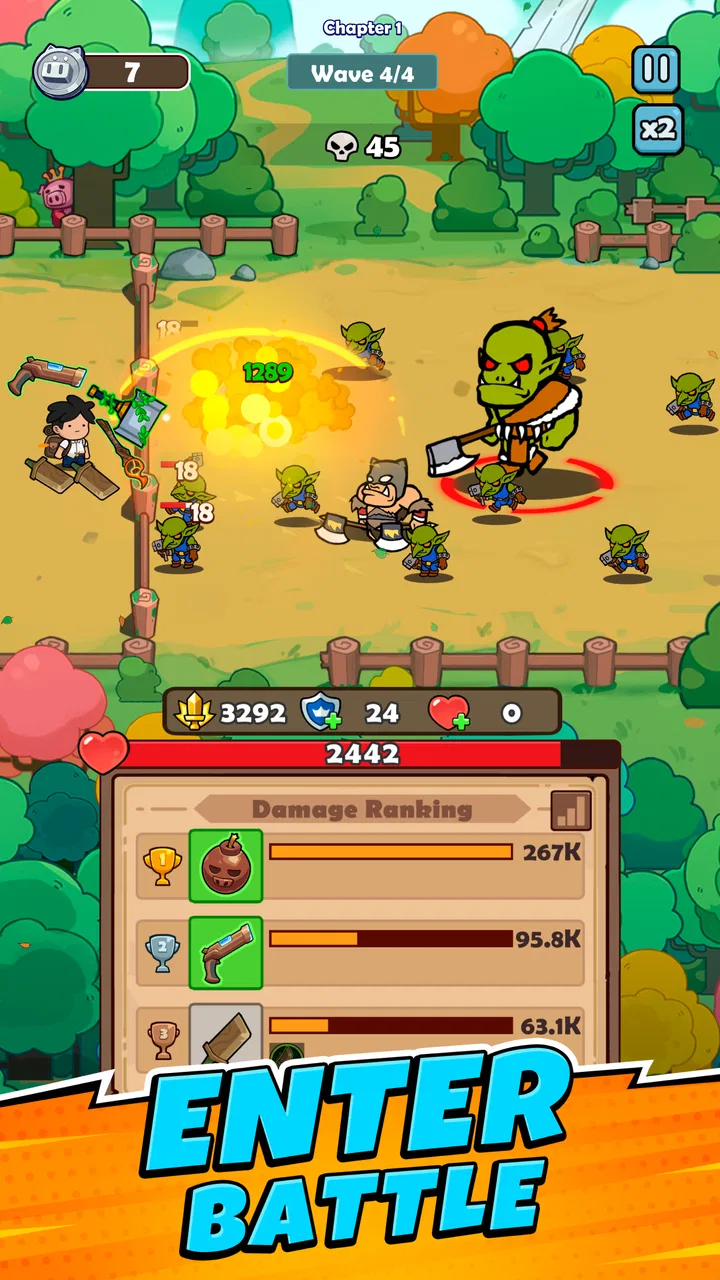
BagMaster Isekai – Bag Battle caught my attention because it turns the backpack into the main strategic puzzle. Instead of treating equipment as a menu I only visit between fights, the game makes arranging and merging weapons part of the battle itself. That single idea gives this free strategy game a more focused identity than a typical automatic RPG, although it also means that players who dislike inventory management may run out of patience quickly.
I spent my time looking at the decisions behind each fight rather than simply tapping through encounters. The central question is not only whether I have a stronger weapon, but whether I can fit the right combination into the limited space available and improve it before the next challenge. That creates a satisfying rhythm: collect useful pieces, reorganize the bag, merge what makes sense, then see whether the new setup survives combat.
Developed by SayGames Ltd, the game is aimed at players who enjoy light RPG progression with a tactical layer. It is free to start and carries an Everyone 10+ content rating. The current release is version 2.4.3, and it runs on devices using Android 8.0 or later. Its audience is already substantial, with more than half a million installs and an average score of 4.5 from roughly 33 thousand ratings, so it has clearly found a receptive group among mobile strategy fans.
You May Also Like

 Blood Strike: 2.5 Anniversary
Blood Strike’s Loadouts Turn Every Drop Into a Tactical Gamble
A close look at Blood Strike’s custom loadouts: how fast access to signature weapons reshapes its battle royale rhythm, rewards preparation, and narrows the gap between fights.

 Pandora - Music & Podcasts
Pandora’s Music Is Easy to Start, but Harder to Recover
Pandora’s strength is its low-effort path from a seed to a station. Its weak spot is how much confidence it asks you to place in connection, setup, and quiet recovery.

 8 Ball Pool
 Is Built on Rivalries, Rematches, and Routine
A close look at the rivalries, rematches, shared routines, and unanswered safety questions that turn a quick pool match into a persistent mobile community.

 Samsung Music
’s Quiet Strength Is Playing What You Already Own
Its reach comes less from spectacle than from dependable access to a personal library. That simplicity is both the app’s strongest retention engine and its ceiling.

 AccuWeather: Weather Radar
AccuWeather Review: A Quick, Clear Forecast for Everyday Decisions
For everyday plans, the best forecast is the one you can understand quickly. AccuWeather makes rain timing, radar, and local conditions easy to act on, with a few trade-offs.

 Hill Climb Racing
Why Hill Climb Racing Still Turns Crashes Into One More Run
A tiny car, a bumpy hill and one more upgrade: Hill Climb Racing keeps resurfacing because its simple chaos makes every near-miss feel personal.
More From Our News Desk



The backpack is the real battlefield
I find the backpack most interesting when I treat it as a plan for the next fight, not a place to keep every weapon I might want later. In this section, I’ll look at how early choices around merging and space can make the game’s goals feel clearer, then turn to the progress signals that help me judge whether a setup is working.
Why merging matters more than collecting
The most important capability here is the ability to merge weapons and turn the backpack into a preparation board. In many mobile RPGs, collecting equipment feels like filling a list: new item in, old item out. Here, the physical arrangement of the loadout gives each item more importance. A weapon is not merely a number attached to a character; it occupies room, competes with other choices, and may become more valuable when combined with a matching piece.
I like that this makes small decisions feel meaningful. A weak item can still be worth keeping if it is close to becoming part of a stronger merge. At the same time, holding onto every possibility creates clutter and may leave the rest of the loadout poorly balanced. The game therefore rewards a player who thinks one or two steps ahead instead of automatically selecting the item with the largest visible value.
The best way to approach the bag is as a limited budget of space, not as a storage box. Every slot should have a reason to exist. If I keep an object only because it might become useful later, I am also accepting the immediate cost of reduced flexibility. That trade-off is the heart of the experience, and it is more interesting than the store summary suggests.
How I read a promising loadout
When I prepare for a battle, I first look for pieces that already belong to a clear upgrade path. I then consider whether the remaining space supports a second useful option or whether I am creating a bag full of half-finished ideas. This prevents a common mistake: filling the backpack with individually attractive weapons that do not work together as a practical setup.
A useful habit is to pause after a merge rather than immediately replacing everything around it. The newly improved weapon may change the balance of the entire bag. A smaller item that seemed unnecessary can become the piece that makes the arrangement efficient, while a previously important weapon may now be taking up room without adding enough value. Rechecking the whole layout is more reliable than making isolated swaps.
This is also where the game feels different from a straightforward idle RPG. In an idle-focused alternative, I would usually spend more time claiming rewards and upgrading a character through menus. BagMaster Isekai asks me to make a spatial decision before I can judge the result. That extra step is the reason to play it, but it is also the main source of friction.
What happens during ordinary play
The practical loop is easy to understand. I gather weapons, work toward merges, arrange my backpack, and enter RPG battles with the setup I have prepared. The combat outcome then gives me feedback about whether my choices were sensible. Even when a fight does not go my way, the result is useful because it encourages me to reconsider the relationship between space, weapon quality, and overall balance.
I found the game most enjoyable in short sessions. It suits the moment when I have a few minutes to make a couple of decisions, test a setup, and close the app. The preparation phase gives those brief sessions a clear purpose. I do not need to commit to a long campaign before seeing the effect of a change, which makes the format comfortable for casual play.
There is a subtle difference between a clever bag and a merely powerful bag. A collection of strong weapons can still be awkward if it leaves no room for useful combinations. Conversely, a more modest collection can perform well when it is organized around a coherent plan. That distinction gives the game more depth than its simple controls initially imply.
A realistic daily use case
Imagine waiting for a bus or taking a short break between tasks. I would open the game, inspect the weapons gathered since the previous session, and decide whether to merge immediately or preserve a piece for a better arrangement. After a quick battle, I could adjust the bag again and stop without feeling that I had abandoned a complicated real-time match.
That scenario is where the design works best for me. The game does not demand constant attention, yet it gives me something concrete to think about. I am not just pressing a reward button; I am deciding what deserves space. If I had a longer uninterrupted session, I could make more changes, but the core decisions remain understandable even when played in small portions.
Where the system creates tension
The backpack mechanic also creates moments of hesitation. Should I use a weapon now because it improves the next fight, or keep it because it may complete a more valuable merge? Should I remove an item that is useful on its own but blocks a better arrangement? These are small questions, but they make the progression feel personal because my decisions shape the result.
I recommend resisting the urge to rebuild after every minor reward. Constant rearranging can turn the game into busywork. I get more value by making a deliberate change when I have a clear reason: completing a merge, freeing a meaningful amount of space, or correcting a setup that repeatedly underperforms. This keeps the tactical element from becoming tedious.
The cost of convenience
Because the game is free, optional purchases are part of the experience. The listed in-app purchase range runs from $0.99 to $99.99 per item. That broad range is worth keeping in mind before starting, especially if I am the kind of player who feels pressure to accelerate progression. I would approach the game with a fixed personal limit and judge each purchase by whether it improves the decisions I enjoy, rather than buying simply to remove a delay.
The purchase structure does not change my view of the central mechanic: the backpack remains the reason to play. Still, players who want a completely frictionless strategy experience should be cautious. If the appeal is making careful choices, speeding through every obstacle can reduce the satisfaction of learning which arrangements work. For me, the game is stronger when I treat progression as a puzzle to solve rather than a queue to skip.
Who gets the most from this design
I would recommend BagMaster Isekai to someone who likes mobile strategy games but wants a compact decision loop instead of a large map, a complicated alliance system, or lengthy battles. It is especially suitable for players who enjoy sorting, combining, and optimizing. The game gives those habits a direct purpose, and the results are visible when a better-organized bag performs more effectively.
It is also a good fit for RPG fans who enjoy equipment choices more than story-heavy presentation. The appeal comes from improving the setup and seeing it work, not from treating the game as a deep narrative adventure. If I wanted a role-playing game built around dialogue, exploration, or a large world, I would choose something else. This is much more focused on the relationship between gear and combat preparation.
Players who dislike inventory screens should probably skip it. The bag is not a side feature that I can ignore while relying on automatic upgrades. It is the capability that determines how engaging the game feels. Someone who wants immediate action with minimal planning may find the pauses between battles more annoying than satisfying.
How it compares with familiar alternatives
Compared with a conventional idle RPG, this game gives me more control over preparation and less reason to simply wait for passive growth. The reward is a stronger sense of ownership: I can identify the decision that improved or weakened a run. The compromise is that progression requires more attention, even though the game remains accessible and suitable for short sessions.
Compared with a traditional strategy game, BagMaster Isekai is much lighter. I am not managing a large economy, positioning a whole army across a map, or learning a long list of systems. Its strategy is concentrated into the backpack. That makes it easier to pick up, but players seeking broad strategic planning may eventually want a game with more layers.
Compared with equipment-focused RPGs that use a simple upgrade button, the merge system gives duplicate or lower-value items a possible purpose. I am encouraged to think about future combinations instead of discarding everything that is not immediately superior. The trade-off is that the bag can become harder to read when too many possibilities compete for limited room.
Questions I would consider before downloading
One practical question is whether the game is suitable for an older phone. The minimum requirement of Android 8.0 makes it accessible to many devices, although real-world smoothness can still depend on the phone and its available resources. I would install it on a device that handles ordinary 2D mobile games comfortably, but I would not assume that every older handset will feel equally responsive.
Another question is whether it can be enjoyed without spending. Since the game is free to download and offers purchases, I would begin without paying and see whether the merging decisions remain enjoyable at my natural pace. The core value is in arranging and improving weapons, so a player who likes gradual optimization should have a reason to try that approach before considering optional spending.
It is also worth asking whether the game is better for quick sessions or long ones. In my view, short sessions are its natural home. The bag gives me a satisfying decision point, and a battle provides immediate feedback. Longer play can still work, but repeated reorganizing may feel less fresh if I approach every reward as a reason to redesign everything.
Finally, I would decide whether I want a game that tests planning through space management. If that sounds appealing, the design has a clear hook that separates it from many casual RPGs. If I would rather collect characters, follow a story, or watch upgrades happen automatically, the same hook becomes a reason to choose another title.
My recommendation after focusing on the bag
What stays with me is not the promise of endless equipment, but the way each weapon asks for a place and a purpose. The merge mechanic makes the backpack feel like an active part of the battle plan. It rewards patience, discourages careless hoarding, and gives me a practical reason to revisit earlier choices.
There is some repetition in the basic cycle, and the optional purchase range means I would play with spending boundaries in mind. The game also will not satisfy anyone looking for expansive strategy or a story-led RPG. Those are fair limitations, but they do not undermine the focused idea at its center.
For me, BagMaster Isekai – Bag Battle works when I approach it as a compact gear puzzle with battles attached. I would recommend it to a friend who enjoys merging items and optimizing a small space, particularly someone who wants a strategy game that fits naturally into brief breaks. The strongest advice I can give is to plan the backpack before chasing the next reward; once I started doing that, the game became much more deliberate and much more enjoyable.
FAQs for BagMaster Isekai – Bag Battle
01What is the main objective of BagMaster Isekai – Bag Battle?
BagMaster Isekai – Bag Battle is a strategy-based role-playing game where players traverse through various fantastical realms. The main objective is to collect and upgrade magical bags, each with unique abilities, to defeat opponents and progress through increasingly challenging battles. Players must strategically manage resources and utilize bag powers effectively to succeed.
02Is BagMaster Isekai – Bag Battle free to play?
Yes, BagMaster Isekai – Bag Battle is free to download and play. However, like many mobile games, it offers in-app purchases. These purchases can enhance gameplay by providing special items, additional bag slots, or cosmetic upgrades. While the game is fully playable without spending money, these purchases can expedite progress or customization.
03What are the system requirements for BagMaster Isekai – Bag Battle?
For Android users, the game requires at least Android 5.0 and 2GB of RAM for optimal performance. iOS users need iOS 10.0 or later. The game is compatible with both smartphones and tablets, but a stable internet connection is recommended to fully enjoy all features, including multiplayer modes and updates.
04How does multiplayer mode work in BagMaster Isekai – Bag Battle?
BagMaster Isekai – Bag Battle features a competitive multiplayer mode where players can challenge others worldwide. Players must strategically choose their bags and utilize their unique abilities to outsmart opponents. The game offers leaderboards, allowing players to track their progress and rank against global competitors. Regular events provide additional challenges and rewards.
05Are there any privacy concerns with BagMaster Isekai – Bag Battle?
The game requires access to certain device permissions, like storage for saving game data and internet for multiplayer features. It adheres to standard privacy practices by collecting minimal personal data necessary for gameplay. Users are encouraged to review the privacy policy to understand how their data is used and protected. Always ensure downloads are from official app stores to avoid security risks.
Pros
- Engaging turn-based combat system.
- Unique bag customization options.
- Vibrant graphics and animations.
- Regular updates with new content.
- Offline mode available.
Cons
- Occasional in-app purchase prompts.
- Learning curve for beginners.
- Some ads can be intrusive.
- Requires frequent internet connection.
- Limited character customization.

BagMaster Isekai – Bag Battle
Gallery